Another possible interpretation of the universe
Based on notes from February 2023
An intuition about black holes, universes born within them, and a cosmos that repeats itself at different scales.
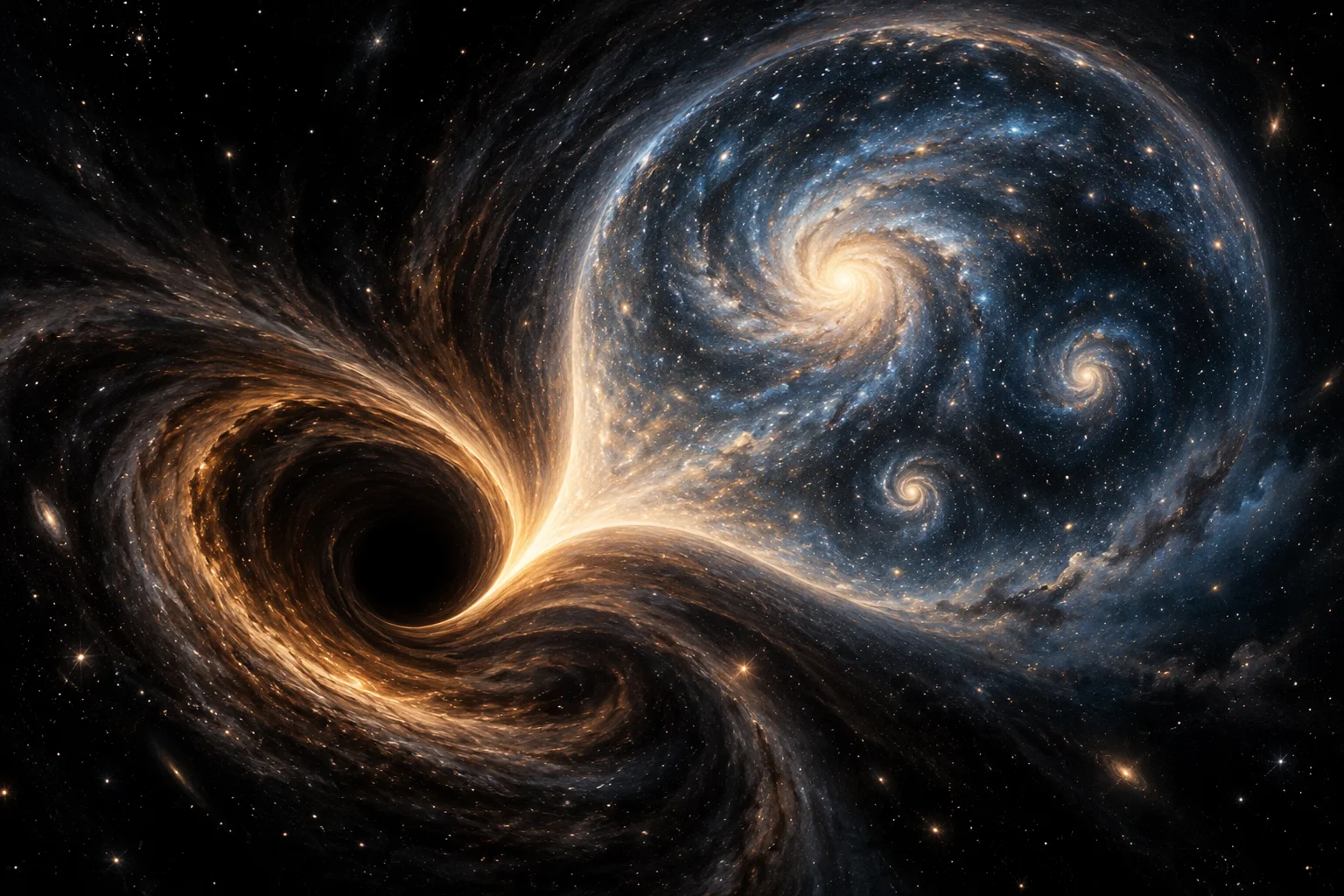
Some ideas are born not necessarily from proof, but from intuition. Sometimes they emerge as we observe patterns that repeat in nature, connect concepts that at first seem unrelated, or simply imagine what might lie behind the things we still do not fully understand.
This is one of those intuitions. It does not claim to be a theory or a scientific explanation of the universe, but one possible way of imagining it.
Perhaps a new instance of the universe forms inside every black hole.
A star dies, collapses, and concentrates an enormous amount of matter until it reaches an extreme point. Perhaps there is a precise quantity of matter there—and possibly some other condition we do not yet know about—from which a new universe can emerge.
A kind of fundamental number: the exact point at which something stops collapsing inward and, from another perspective, begins to expand.
After its birth, the black hole continues to absorb matter. From the universe within it, that matter could manifest as new matter appearing in different regions, fueling its expansion.
And if time is relative, the rate at which the black hole takes in matter from outside would not necessarily have to alter the sequence of events within the new universe. For anyone living there, everything could unfold along a continuous timeline.
If this were so, we could even imagine that each new universe begins under similar conditions: the same initial amount of matter, the same fundamental rules, and a sequence of events that, at least in principle, could repeat itself.
A duality would then emerge, reminiscent of others we constantly encounter in nature.
On one side, a black hole: collapsing matter, darkness, concentration.
On the other, a Big Bang: expanding matter, light, dispersion.
Two sides of the same phenomenon. Something like Yin and Yang: what looks like an ending from one side could, seen from the other, be a beginning.
We could take this intuition a little further.
We know that galaxies are moving apart and that supermassive black holes exist at the centers of many of them. Perhaps what we call the “universe” could be thought of, on another scale, as something contained within the boundaries of a galaxy.
Over time, the central black hole could continue taking in that galaxy’s matter while a new universe develops inside it.
From this perspective, even the light that crosses a black hole’s horizon could continue its journey within that new space.
Then an even stranger possibility arises: what if our own universe were contained inside a black hole?
Our Milky Way could be, from our perspective, the universe we inhabit, while what we observe beyond it could belong to outer levels of a much larger structure.
The galaxies we see could exist outside our own “black-hole universe.” And some of them could, in turn, belong to structures contained within even larger ones.
A succession of layers: black holes within universes, universes within black holes.
A kind of recursive structure of the cosmos.
Recent observations by telescopes such as James Webb, which have revealed extremely ancient and surprisingly developed galaxies at very early stages of the observable universe, also invite us to ask how much we really understand about its first moments.
Perhaps some of the things we observe are not only different places, but also different stages of the same structure.
If each black hole gives rise to a universe under similar conditions, then perhaps what we see at enormous distances is, in some way, the same universe passing through different moments of its existence.
And as we look outward, trying to understand where we came from, exactly the opposite could be happening at the center of our own galaxy: the slow formation of another universe.
A universe that will one day contain the matter of our own.
A new beginning born within what, from here, we understand as an ending.